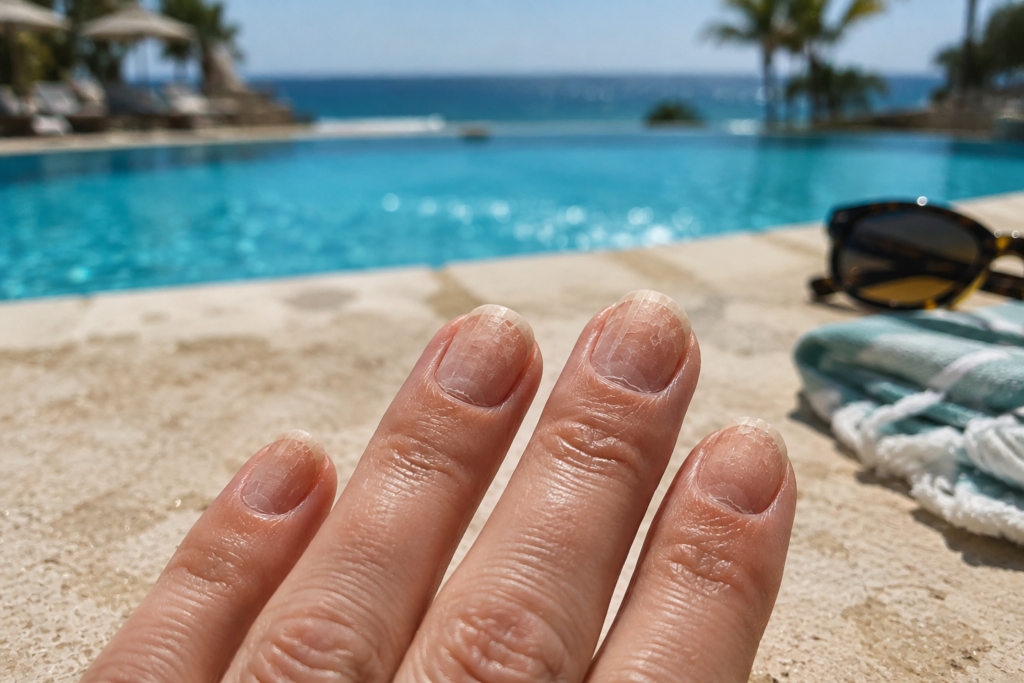

You've noticed the ridges. Little raised lines running along your nails, catching the light in a way that bothers you every time you look down. And now you want them gone, smooth, buffed away so your polish sits flat like it's supposed to.
I understand the instinct completely. But before you reach for a buffer, or ask me to sort it at your next appointment, there's something worth understanding about ridges. Not all of them are the same, and how I handle them depends entirely on which kind you've got.
This post is about what I'll do at my desk, and what I won't. Because there's a line I don't cross, and knowing where it sits keeps your nails healthier.
The two kinds of ridges, and why the direction matters
When people talk about ridges in nails, they're usually talking about one of two things, and they run in different directions.
Lengthways ridges run from your cuticle down to the tip of the nail, following the direction your nail grows. These are the ones most people notice. They tend to become more visible over time, and they're extremely common. I see them constantly.
Ridges running across the nail go the other way, sideways, from one edge of the nail to the other. These are far less common, and they're a completely different situation. If you've got horizontal ridges across several nails, that's not something I'll buff out. I'll send you to get it checked instead. More on that further down, because it matters.
The direction genuinely changes what I do. So the first thing I do when someone points out their ridges is look at which way they run.
Lengthways ridges: what I can work with
Vertical ridges in nails, the lengthways kind, are something I can absolutely help with at the desk. They're one of the most common things clients ask me about, and there's a sensible way to deal with them.
But I want to be honest about what "help" means here. I'm not removing them. I'm working with them.
Here's the thing I want you to hold onto: lengthways ridges are very common, and I still want anything new or changing looked at. Common isn't the same as "ignore it". If your ridges have appeared suddenly, changed, or come alongside anything else you've noticed about your nails, mention it to your GP or pharmacist. I'm a nail technician, not a clinician, and there's a proper place for that conversation. It isn't my chair.
What I can do is make the surface of your nail look and feel smoother without stripping it back.
Why I won't buff ridges away
This is the part I feel strongly about, so bear with me.
Buffing a ridge flat means removing nail. To get a raised line level with the rest of the plate, you have to file down everything around it until the surface is even. That's not smoothing. That's thinning.
Your nail plate isn't one solid sheet. It's made of layers of keratin pressed together, and every pass with a buffer takes some of those layers off. Do it once and you probably won't notice much. Do it every few weeks, chasing ridges that keep coming back, and you end up with a nail that's thinner, weaker, and more prone to peeling and splitting than when you started.
I've written before about how over-buffing thins the nail plate and makes peeling worse. The same logic applies here. You'd be sanding down healthy nail to chase a cosmetic line, and you'd be left with something more fragile in exchange.
So no. I won't buff your ridges out. Not because I can't make them look smoother, but because there's a better way that doesn't cost you nail.
What I do instead: a structured overlay
Here's the approach that actually works. Instead of filing the nail down to meet the ridges, I build the surface up to meet the high points.
A structured builder gel overlay is self-levelling. That means the product settles into the low areas of the nail and levels the surface, filling in around those lengthways lines rather than removing anything. Once it's cured, you get a smooth, even surface for colour to sit on, and the ridges underneath are still exactly where they were, safely covered rather than sanded off.
It's the difference between filling a slightly uneven floor and taking a sander to the whole thing. One levels without loss. The other costs you material you can't get back.
There's a real bonus, too. Builder gel adds a bit of strength and structure while it's on, which is a genuine plus if your nails are on the thinner or bendier side. If you want to understand how a structured service differs from a straightforward gel polish finish, I've broken it down in my post on gel manicures versus structured manicures.
Good prep matters here as well. I work with a dry manicure and precise e-file prep rather than aggressive buffing, so the overlay bonds properly without me thinning your natural nail to get there.
Ridges across the nail: the ones I always refer
Now the important part.
Horizontal ridges, the ones running across the nail rather than down it, are on my always-refer list. If you've got them across several nails, I won't buff them, I won't overlay to hide them, and I won't tell you what they might mean, because that isn't my job and it wouldn't be safe for me to guess.
What I'll do is tell you plainly that it's worth getting checked. I'd point you towards the NHS page on nail problems and suggest you have a word with your GP or pharmacist rather than trying to sort it cosmetically.
That isn't me being overly cautious or passing the buck. Your nails can reflect what's going on elsewhere, and a professional who's actually qualified to look into that is the right person for the job. I can make nails look lovely. I can't and won't do anything that belongs in a clinical setting.
When to speak to your GP or pharmacist
Please book in with your GP or speak to a pharmacist if:
- You've noticed ridges running across your nails, especially across several nails at once.
- Any ridge or line has appeared suddenly or changed.
- The change comes alongside anything else you've noticed, such as a difference in colour, texture, thickness, or shape.
- Your nails have changed and you're worried, full stop. You don't need my permission or a specific symptom to get something checked.
A pharmacist is a great first port of call and can tell you whether you need to see your GP. There's no such thing as wasting their time on this.
The honest takeaway
Lengthways ridges are very common, and I can give you a smooth, even finish with a structured overlay that levels the surface without removing your nail. That's the sensible way to handle them, and it's what I'll offer you at the desk.
What I won't do is buff healthy nail away to chase a cosmetic line, and I won't touch ridges running across the nail. Those go to your GP or pharmacist, every time.
If you're not sure which kind you've got, bring your hands to your appointment and I'll take a look. I can tell you what I'm comfortable working with, and I'll be straight with you about anything I think is better looked at elsewhere. That honesty is part of the service, not a bolt-on.
I'm Beckie, a qualified nail technician, not a medical professional. Nothing in this post is a diagnosis or medical advice. If you're worried about any change to your nails, please speak to your GP or pharmacist.