
Your nails were fine for forty years. You never thought about them much. Then, seemingly overnight, they started splitting at the tips, peeling in layers, and growing at a snail’s pace.
You haven’t changed your polish, your hand cream, or anything you do. So what’s going on?
Here’s what nobody selling you supplements will tell you plainly: your nails changed because your hormones did. I see this every month at my desk, in women who are quietly convinced they’ve done something wrong. You haven’t. Let me explain what’s actually happening, what helps, and what’s a waste of your money.
What you’re probably noticing
Most women in their mid-forties and beyond describe the same cluster of changes, and they usually appear together rather than one at a time.
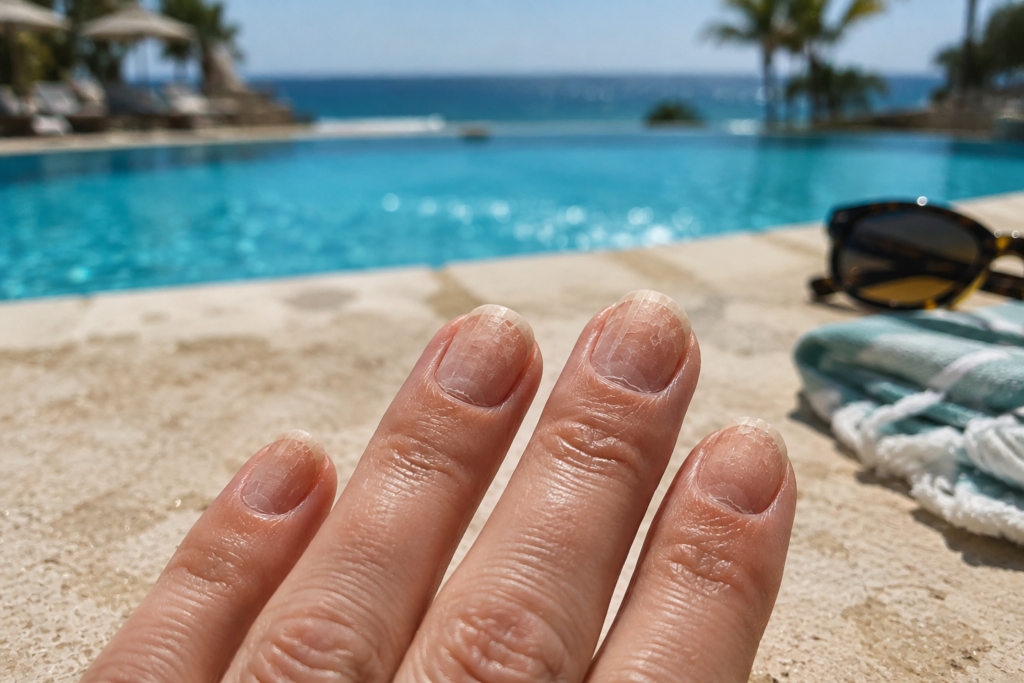
The nails feel brittle. They snap or tear when they never used to, often at the free edge. They peel into thin layers, especially at the tips. They feel dry no matter how much hand cream you use.
Growth slows down noticeably. The set that used to grow out in three weeks now takes five. And the ridges running lengthways from cuticle to tip become far more pronounced than they were.
If you’re reading that and recognising your own hands, you’re not imagining it and you’re not doing anything wrong.
Why it’s happening
Your nail plate is made of keratin, and keratin production is influenced by oestrogen. Oestrogen also helps your body retain moisture and supports healthy circulation to the nail matrix, which is an area under your skin where new nail is made.
During perimenopause and menopause, your oestrogen drops. Less oestrogen means less moisture retention, slower keratin production, and reduced circulation to that matrix. The result is a nail plate that’s drier, weaker, and slower to grow.
Think of your nail plate as a brick wall. The keratin layers are the bricks, and moisture is the mortar holding them together and keeping them flexible. When oestrogen was plentiful, the mortar stayed supple and the wall held together beautifully. As oestrogen falls, the mortar dries out and starts to crumble. The bricks begin to separate, and that’s the peeling and splitting you’re seeing.
It’s worth knowing the difference between a nail that’s genuinely weak and one that’s simply dehydrated, because the fix isn’t always the same. I’ve written about weak nails versus dehydrated nails if you want to work out which one you’re dealing with.
What actually helps at home
None of this is exotic or expensive. It’s consistency that matters, not fancy products.
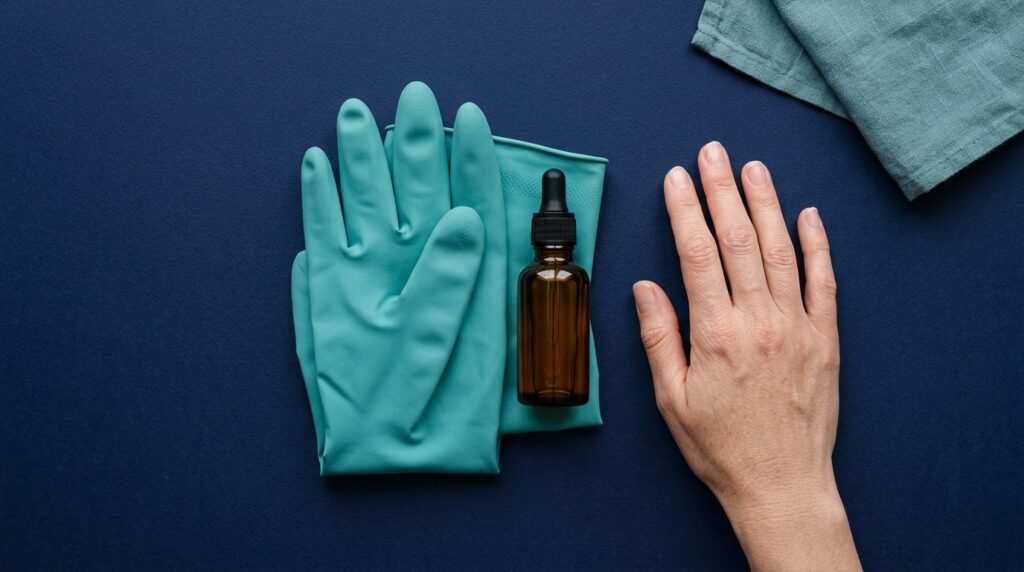
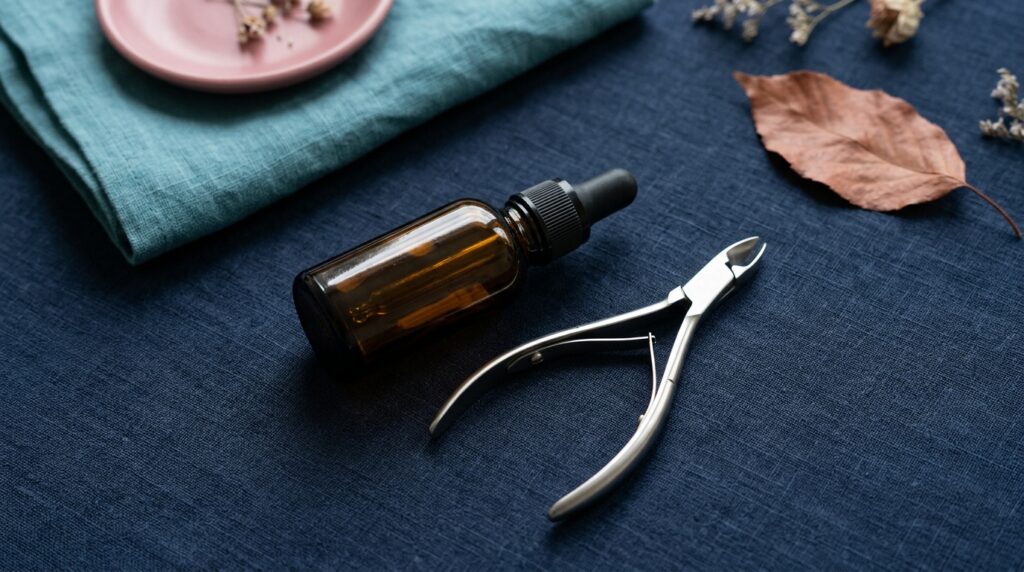
Oil, every single day. If your nail plate is drier, you need to put moisture back into it. Cuticle oil is the single most useful thing you can do, and it needs to be daily, not just when you remember. I go into the full reasoning in why cuticle oil is not optional, and it’s never mattered more than it does now.
Gloves for wet work. Washing up, cleaning, gardening. Water swells and shrinks the nail plate repeatedly, and household chemicals strip it further. Rubber gloves are not glamorous , but they work.
File, don’t cut. Brittle nails shatter when you clip them. Use a gentle file and shape in one direction to avoid tearing those already-fragile layers.
Look at your plate. Protein is the raw material your nails are built from, and iron matters for circulation and healthy growth. This isn’t about supplements, it’s about eating properly. If your diet has quietly narrowed over the years, it’s worth a look.
For a fuller rundown, my post on brittle nails, causes, remedies, and prevention covers the ground in more detail.
What helps in the salon
This is where a professional service earns its place, and it’s honestly the situation the Structured Manicure was made for.
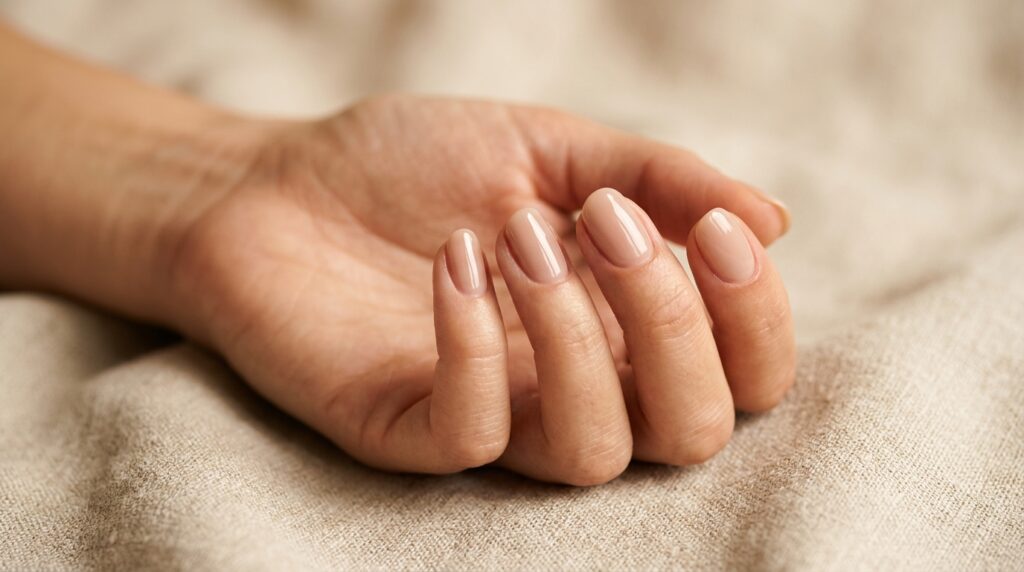
When your natural nail plate has lost the strength it used to have, a thin builder gel overlay does something your own nail currently can’t: it adds a layer of protection and rigidity across the plate. That means the new growth coming through underneath is shielded while it grows, rather than snapping off before it ever reaches a decent length.
It’s not covering up a problem. It’s giving your nails a reinforced structure to grow behind while your hands adjust to their new normal. If you want to understand how it differs from a standard gel service, I’ve explained the Structured Manicure versus a gel manicure properly here.
For a lot of my clients over 45, this is the thing that finally breaks the cycle of grow-a-bit, snap, start-again.
What’s a waste of your money
I’ll be straight with you, because the internet won’t.
The supplements marketed specifically as “menopause nail” formulas are, for the most part, expensive repackaging. There’s rarely anything in them you couldn’t get from eating well.
Biotin is the one everyone reaches for. The evidence for biotin improving nails is weak unless you’re genuinely deficient, and most people aren’t. If you are deficient, that’s a conversation for your GP with a proper test, not a guess and a monthly subscription.
Save your money. Put it towards good cuticle oil and a service that actually protects your nails.
When it isn’t menopause
One important caveat, and then I’ll stay in my lane.
Thyroid problems and iron deficiency both cause nail changes that look almost identical to hormonal ones, and they tend to cluster around the same stage of life. Brittle, slow, ridged, peeling: all of these can point to more than one cause.
If your nails have changed suddenly and dramatically, or alongside other symptoms like fatigue or hair changes, please have a chat with your GP. It’s a simple blood test and worth ruling out.
And on that note: some women do notice their nails improve on HRT, since it addresses the oestrogen drop directly. Whether HRT is right for you is entirely a conversation for your GP, not your nail tech.
What to do with all this
Start with the two things that cost almost nothing: oil daily and gloves for wet work. Give it a month. Then, if your nails are still fighting you, book in for a service that protects the plate while it grows rather than expecting your natural nail to cope alone.
And if anything changed suddenly or feels off, visit your GP. Rule out the medical stuff first.
Your nails aren’t broken and you haven’t failed them. They’re responding to a real, physical shift, and once you understand the mechanism, the fixes make sense.
If your nails have changed and you want them looked after by someone who understands why, book a Structured Manicure. I see hands like yours every week, and there’s a lot we can do.