
You know the drill. Hands in your pockets. Fists closed in every photo. Reaching for something across the table and then thinking better of it, because someone might see.
If you’ve bitten your nails for years, you’ve probably built a whole set of small habits around hiding your hands. And I’d bet the idea of sitting across from a nail tech, palms up, under a lamp, feels like the last thing you’d ever willingly do.
So let me answer the question you came here with. Yes, you can put gel nails on bitten nails. I see them all the time. They don’t shock me, they don’t put me off, and they don’t change how I feel about a client for one second. To me they’re just a starting point, and one I can almost always work with. If you’re reading this hoping someone will tell you your nails aren’t beyond help, they very likely aren’t.
Why gel nails on bitten nails work when willpower doesn’t
Here’s the thing nobody tells you when they hand you a bottle of bitter-tasting polish. Nail biting, or onychophagia if we’re being formal about it, is usually something you do without noticing. You’re on a call, watching something, thinking about a deadline, and your hand is at your mouth before your brain has registered a decision.
You can’t out-discipline a habit you don’t know is happening. That’s why “just stop” and willpower alone tend to fail, over and over, and why each failure feels like a personal one. It isn’t. You’re trying to interrupt something automatic with something conscious, and the automatic thing wins nearly every time.
How an enhancement actually helps you stop
This is where nails become a genuine tool rather than just something pretty. An enhancement helps in three specific ways, and they work whether you’re thinking about it or not.
First, it’s a physical barrier. A well-applied overlay in builder gel or a set of acrylic nails is hard. Teeth can’t get through it the way they get through a soft, natural free edge. The usual bite just doesn’t land, and that pause is often enough to bring the habit back into your awareness.
Second, it’s an investment you don’t want to wreck. When you’ve spent time and money on something and it looks good, you protect it. That’s not vanity, it’s just how people behave. Your hand goes up, you catch sight of your nails, and you stop.
Third, and this one gets overlooked: smooth edges. Most biting sessions don’t start with a craving. They start with a snag. A rough free edge, a bit of loose skin, something that catches, and suddenly your teeth are “just tidying it up.” An enhancement gives you a smooth, sealed edge with nothing to catch on. Remove the snag and you remove the trigger.
“But my nails are too short for this”
This is the assumption I most want to argue with, because it’s the one that keeps people away.
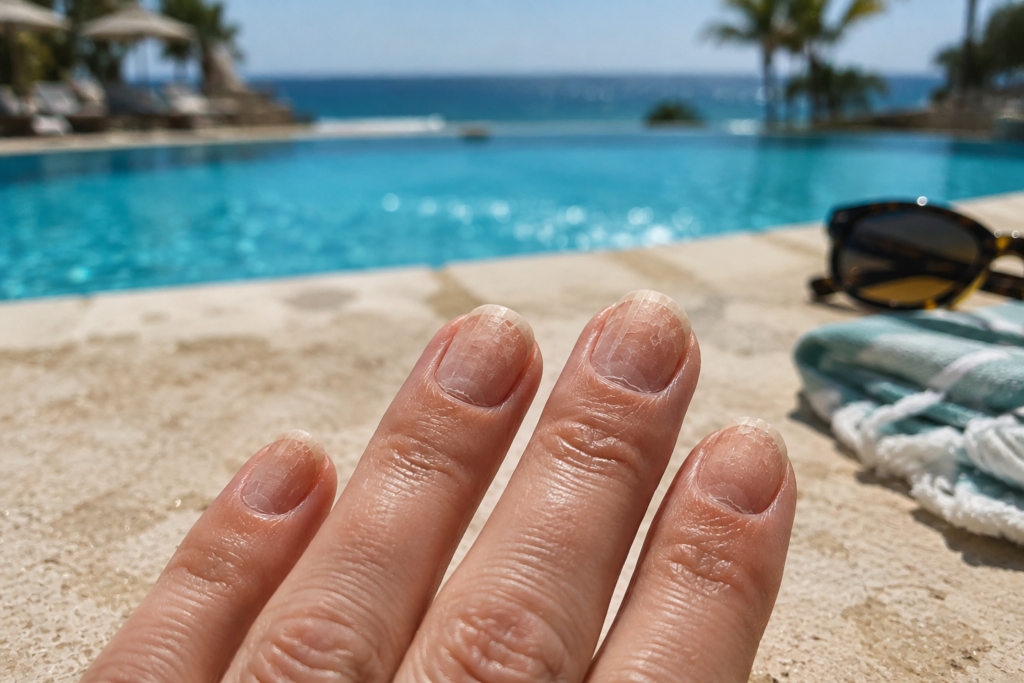
You do not need length to start. You need a little bit of nail plate for the product to bond to, and most people who bite still have that, even when they’re convinced they don’t. If there’s any free edge at all, I usually have something to work with using an overlay to strengthen and protect what’s there while it grows.
If your nail beds are very short, or you tend to bite the skin at the sides too, I’ll be honest with you about that in the consultation. Sometimes the first appointment is about strengthening and protecting rather than adding dramatic length, and we build from there. That’s the approach I take with the nail bed rule anyway, so nothing about bitten nails changes my honesty on what’s realistic.
I’d rather tell you the truth about your starting point than promise you the moon and disappoint you. That honesty is the point. It’s how you’ll know you can trust what I tell you next.
If any part of you is nodding along here, this is the moment to book a consultation. Bitten nails are welcome. Truly.
The grow-out journey, month by month
Let’s be realistic about what happens next, because knowing the timeline helps you stick with it.
The first set feels strange. You’ll be very aware of your nails, you’ll knock them on things, and you might not love how they look immediately if you’re used to nothing being there. That settles within a week or so.
Over the first month, the barrier does its quiet work, and your natural nail starts growing underneath without being interrupted. As the free edge extends, your nail beds actually look longer. That visual change is often the first time people feel genuinely encouraged.
By around the three-month mark, with regular infills every three to four weeks, most people are somewhere they wouldn’t have believed at the start. Not perfect. Just better, and heading in the right direction.
Regrowth is slow, and relapses happens. A stressful week, one nail that catches, and you slip. That is not failure, it’s just part of it. You reset at your next appointment and carry on.
What to do between appointments
Keep cuticle oil on you and use it a few times a day. Soft, hydrated skin around the nail gives you far less to pick at.
If you feel a snag, file it smooth straight away rather than testing it with your teeth. And find something to keep your hands busy when you know you’re vulnerable: a fidget object, a pen, a cup of tea to hold.
Why the private setting makes the difference
For a lot of my clients, this is the deciding factor. I work one-on-one. No busy salon floor, no row of other chairs, no audience watching me lift your hand and see what state it’s in.
It’s just you and me, and there’s no judgement in the room. If showing your hands is the thing that’s stopped you booking for years, a private space is exactly what removes that wall.
One thing to check first
If the skin around your nails is broken, sore, or looks infected, please see your GP before any enhancement work. I can’t work over broken or inflamed skin safely, and your health comes first.
Where to start
If you take one thing from this, let it be that your nails are not too bad to show me. They’re a starting point, and I’ve seen and worked with hundreds like them.
An enhancement won’t magically cure a lifelong habit, but it genuinely helps most people who try it. It gives your teeth something solid to come up against instead of soft natural nail, it turns your hands into something you’ve paid for and want to keep looking after, and by sealing off every rough edge it takes away the little snags that so often kick a biting session off. If you want to know what the options actually look like, have a read of my guide comparing a gel manicure and a structured manicure, or my guide to soft gel tips if you’re after extensions.
When you’re ready, book a consultation. Bitten nails are welcome here, and always will be.
FAQs
Can a nail tech tell I bite my nails?
Yes, we can tell. And I promise you I don’t care. I see it constantly, it tells me nothing about you as a person, and it doesn’t change how I treat you or your nails for a second.
How short is too short for gel?
If there’s any free edge at all, I usually have something to bond to. Truly bitten-to-the-skin nails may need strengthening work first before length, and I’ll tell you honestly what’s realistic at your consultation rather than overpromising.
Will extensions stop me biting?
They help most people, and often significantly. They’re not a guaranteed cure, and relapse is normal. What makes the difference is that the enhancement removes the automatic route to your teeth in a way sheer willpower never manages, and that changes the odds for the better.