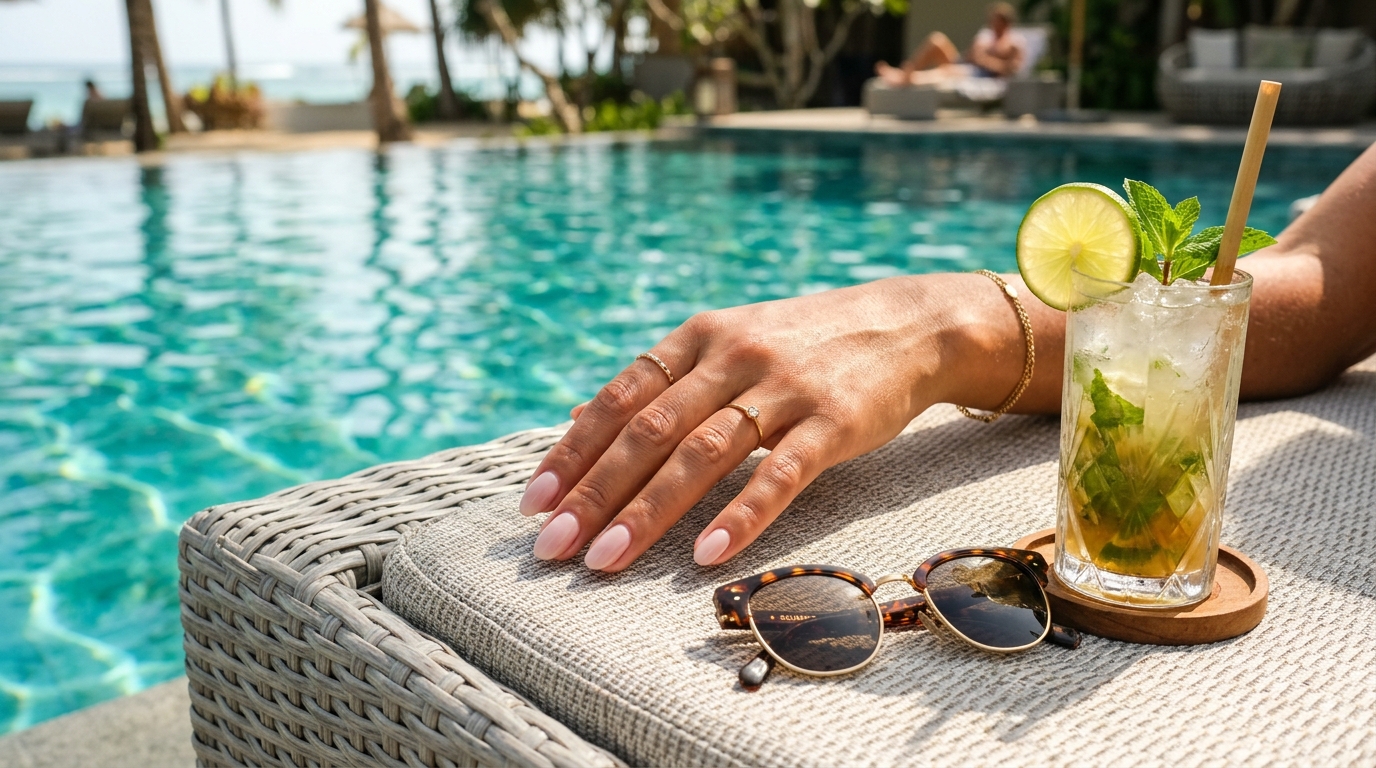
You’ve spent good money on a fresh set. They look perfect. Then you spend a week by the pool, and by day three, something’s not right. A nail lifts. The colour looks dull. One edge catches on a towel and that’s the beginning of the end.
Summer holidays are tough on nails. Not because your manicure was done badly, but because chlorine, salt water, sun cream, and heat all work against the bond between your enhancement and your natural nail. The good news is that most of the damage is preventable, if you know what you’re dealing with.
Why Holidays Are Hard on Enhancements
Your nails go through a lot in a typical week at home. On holiday, everything intensifies.
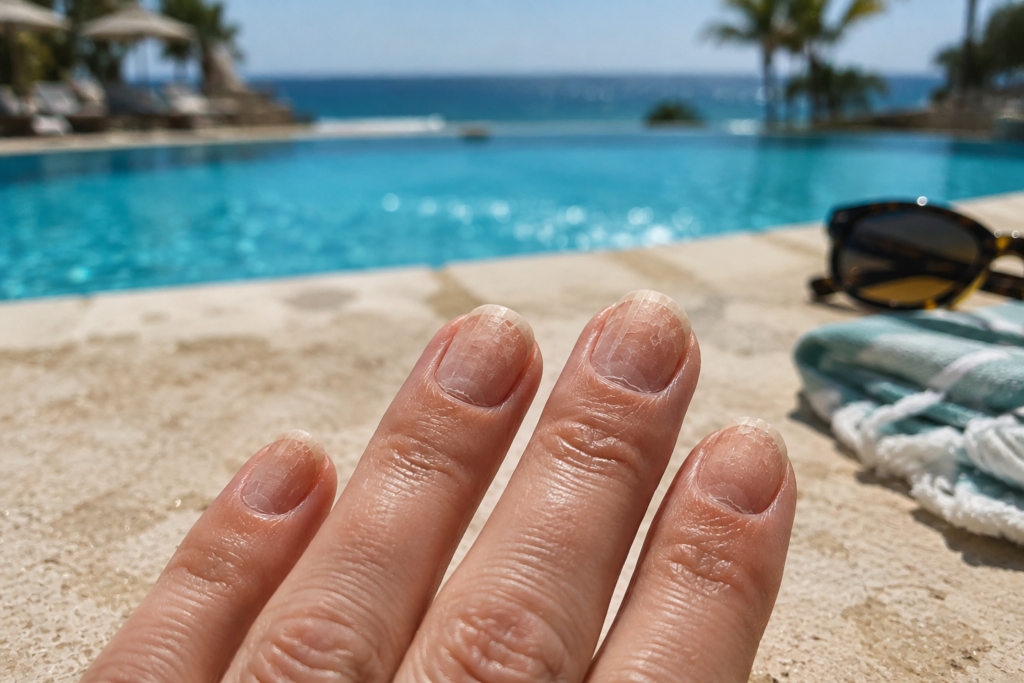
Chlorine in pools is a disinfectant. It’s designed to break things down. That includes the oils in your skin and the moisture in your nail plate. Repeated exposure dries out the nail underneath your enhancement, which can cause it to shrink slightly. When your natural nail contracts and your enhancement doesn’t, that’s when lifting starts.
Salt water does something similar but in a different way. It draws moisture out of the nail plate through osmosis. If you’ve ever noticed your nails feel particularly dry and brittle after a beach holiday, that’s why.
Then there’s sun cream. It’s essential for your skin, but most formulas contain oils and chemicals that can break down the surface of gel polish and soften the edges of enhancements. If you’re reapplying SPF every couple of hours (as you should), your nails are getting coated repeatedly.
And heat? Heat makes your nail plate expand. If you’ve been lying in 35-degree sun and then plunge your hands into a cold pool, that rapid change can stress the bond between your natural nail and the product sitting on top of it.
None of this means your nails are doomed. It just means you need to give them a bit of extra thought.
Chlorine: The Biggest Culprit
If I could give you one piece of advice for pool holidays, it would be this: rinse your hands with fresh water after every swim.
Chlorine sits on the nail surface and continues to work even after you’ve left the pool. A quick rinse under a tap or a shower removes the residue before it has time to do real damage. It takes ten seconds.
If you’re someone who spends hours in and out of the pool, consider applying a thin layer of cuticle oil before you swim. It won’t last forever in the water, but it creates a small barrier that helps. I’d also recommend reapplying cuticle oil after your post-swim rinse, once your hands are dry.
The drying effect of chlorine is cumulative. One swim probably won’t cause problems. Five days of multiple pool sessions without rinsing? That’s where lifting creeps in.
Salt Water and Sand
Salt water is less immediately harsh than chlorine, but it’s still dehydrating. The same rinse-and-oil routine applies.
Sand is the other thing to watch. It acts as a fine abrasive, and if it gets under the free edge of your enhancement, it can start to lever it away from the natural nail. Be mindful when you’re towelling off or digging around in the sand. If you feel grit under a nail, don’t ignore it. Gently rinse it out rather than picking at it.
Picking at anything around your enhancements is one of the fastest ways to cause damage. If something feels loose or lifted, leave it alone until you can get it looked at properly. Pulling at a lifted nail risks peeling layers of your natural nail away with it, and that takes months to grow out.
Sun Cream and Your Manicure
I’m not going to tell you to stop wearing sun cream. That would be absurd.
What I will say is that certain ingredients in SPF formulas, particularly oil-based and chemical sunscreens, can dull the surface of gel polish over time. You might notice your nails lose their glossy finish during a week away. This isn’t a sign of a bad manicure. It’s a reaction to what you’re putting on your hands multiple times a day.
A few things that help:
Wash your hands after applying sun cream, once it’s had time to absorb into your skin. This removes the excess product sitting on your nail surface.
If you’re using a spray sunscreen, try to avoid spraying directly onto your nails. Easier said than done, I know, but it makes a difference.
And again, cuticle oil. It keeps everything hydrated and helps maintain that glossy finish. You’ll notice a theme here.
Cuticle Oil Is Your Best Travel Companion
I talk about cuticle oil a lot. I know. But there’s a reason it comes up in nearly every nail care conversation.
In summer, your nails face dehydration from multiple angles: chlorine, salt, sun, heat, air conditioning in hotels. Cuticle oil counteracts all of it. It replenishes the moisture in your nail plate and the skin around your nails, and it helps maintain the flexibility that keeps enhancements bonded properly.
Pack a small bottle in your hand luggage. Apply it morning and night at a minimum, and ideally after every swim or hand wash. If your nails feel dry or tight at any point, that’s your cue.
If you’re not sure what’s going on with your nails, whether they’re genuinely damaged or just in need of some attention, my guide to healthy, strong nails is worth a read before you go away. And if you want to understand why cuticle oil specifically matters so much, I’ve written a dedicated guide to cuticle care that goes into more detail.
Timing Your Appointment Right
This one’s practical rather than glamorous, but it matters.
Try to book your pre-holiday appointment no more than a few days before you travel. The closer your manicure is to fresh, the better the bond, and the less likely you are to have any natural growth at the base that could catch or lift during the trip.
If you’re wearing acrylics and you’re due an infill, don’t push it to “after the holiday.” Get it done before you go. A freshly infilled set with good adhesion will handle a week of pools and beaches far better than one that’s already three weeks grown out.
And if you’re considering taking a break from enhancements and going bare for your trip, that’s absolutely fine too. Just make sure you’re looking after your natural nails with oil and a good nail hardener if needed.
What to Do If Something Goes Wrong on Holiday
Sometimes a nail lifts, an edge chips, or a tip snaps. It happens, no matter how careful you are.
Here’s what to do, and what not to do.
If a nail lifts at the edge: don’t glue it down yourself with superglue. I know it’s tempting. Superglue traps moisture underneath the enhancement, and moisture trapped against your nail plate is exactly how green nail syndrome develops. Instead, keep the area clean and dry. Apply antiseptic if you have it, and get it seen to when you’re home.
If a tip breaks: file the edge smooth if you can, to stop it catching on things. A glass nail file is small enough to pack and does a better job than an emery board. Don’t try to repair it with household glue or anything from a hotel first aid kit.
If gel polish chips: leave it. A small chip won’t worsen dramatically over a few days. Picking at it will.
The general rule is: don’t try to fix it yourself in a way that could make things worse. A few days of imperfection is far better than weeks of nail damage.
A Quick Pre-Holiday Checklist
Before you head to the airport, make sure you’ve got these sorted:
- Book your nail appointment for as close to your departure date as possible
- Pack cuticle oil in your hand luggage (keep it under 100ml)
- Throw a glass nail file in your toiletry bag
- Commit to rinsing your hands after every swim
That’s it. Nothing complicated. Nothing expensive. Just a few small habits that make a real difference.
Your Nails Can Handle a Holiday
Summer doesn’t have to mean sacrificing your manicure. Chlorine, salt water, sun cream, and heat are all manageable if you understand what they do and take basic steps to counteract them.
The clients who come back from holiday with their nails still looking great aren’t lucky. They’re just prepared. A little cuticle oil, a quick rinse after swimming, and the sense to leave things alone when something goes wrong. That’s all it takes.
Enjoy your holiday. Your nails will be fine.