“HEMA-free” is doing a lot of heavy lifting on product labels right now. Since gel allergies hit the headlines — and a government investigation into gel polish reactions made the news — the phrase has become the beauty industry’s favourite reassurance. Brands print it on bottles. Salons print it on price lists. I use HEMA-free products myself.
But I need to be straight with you: HEMA-free does not mean allergy-proof. People have had confirmed allergic reactions to gel polishes marketed as HEMA-free. If you’re choosing a salon (or a DIY kit) based on that label alone, you’re trusting the wrong safeguard.
Let me explain what the label actually tells you, what it doesn’t, and what genuinely keeps your skin safe.
A 60-second HEMA refresher
HEMA (2-hydroxyethyl methacrylate) is a monomer — a small, reactive molecule found in most gel polishes, builder gels, and acrylic systems. When your nails go under the lamp, these monomers link together into a hard, stable polymer. That finished, fully cured surface is inert and sits harmlessly on your nail.
The problem is uncured monomer. If liquid gel touches your skin, or the gel isn’t cured properly, those reactive molecules can penetrate and teach your immune system to treat them as a threat. That’s sensitisation. Once it happens, it’s permanent — and HEMA is the single most common culprit. It’s such a frequent offender that dermatologists added it to Europe’s standard allergy testing panel in 2019.
So removing HEMA from a formula is a genuinely good idea. It removes the most likely troublemaker. What it doesn’t do is remove the mechanism.
The proof: reactions to HEMA-free products are documented
This isn’t me being cautious for the sake of it. In a published medical case, a patient developed allergic contact dermatitis — on her nail beds and her jawline — from a gel polish advertised as HEMA-free. Allergy testing confirmed strong reactions to other acrylates in the product, including methyl methacrylate. The HEMA-free polish itself produced a strong positive reaction on her skin.
Zoom out and the numbers back this up. When UK and Irish dermatology units audited nearly 5,000 allergy-tested patients, 1.5% reacted to HEMA — but 2.4% reacted to at least one (meth)acrylate. In other words, a meaningful share of gel allergies were never about HEMA in the first place.
Why HEMA-free products can still sensitise you
Three reasons.
1. HEMA has cousins
HEMA belongs to a large chemical family called (meth)acrylates. A “HEMA-free” gel still needs monomers to cure, so it uses relatives — di-HEMA TMHDC, HPMA, IBOA, and others. These can cause allergies in their own right.
2. The family cross-reacts
Because these molecules are so structurally similar, an immune system sensitised to one frequently reacts to others. Someone who developed a HEMA allergy from a cheap DIY kit can go on to react to a premium HEMA-free system, because their body recognises the whole family, not one member.
3. The label says nothing about application
Sensitisation needs skin contact with uncured product. That happens when gel floods the cuticle, when layers are applied too thickly to cure through, or when a polish is cured under the wrong lamp. A brand’s formula can’t control any of that. The hands applying it can.
Think of “HEMA-free” like SPF 50. It’s meaningful protection, and I’d always choose it over the alternative — but it doesn’t make lying in the midday sun for six hours safe. The behaviour matters as much as the bottle.
What actually reduces your risk
If the label isn’t the safeguard, this is:
Skin contact — none, ever. Gel belongs on the nail plate only. A careful tech leaves a tiny margin around the cuticle and sidewalls rather than flooding them for an “up to the skin” look. If product touches skin, it should be cleaned off before curing, not cured in place.
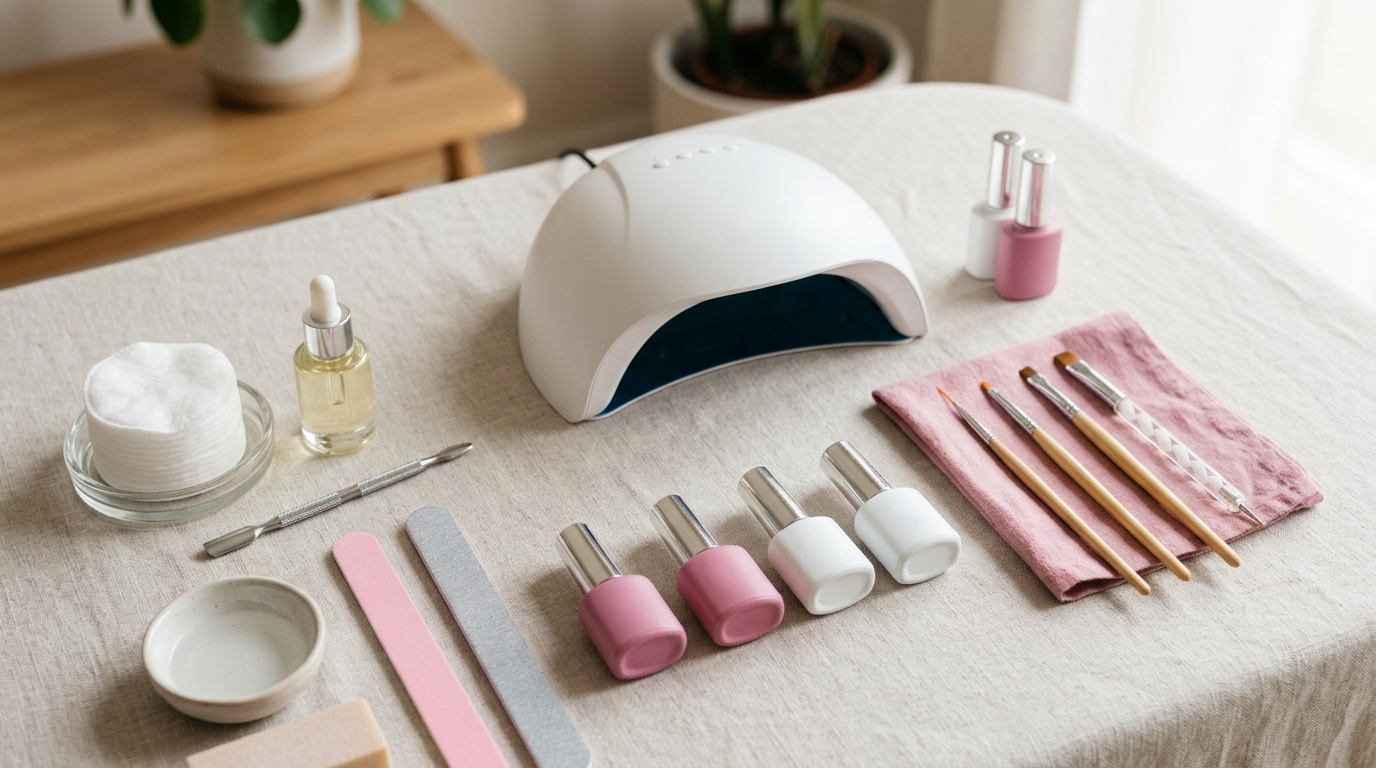
The matched lamp. Gel formulas are developed to cure under a specific lamp at a specific wavelength and power. The wrong lamp under-cures the gel, leaving live monomer sitting against your nail for weeks. This is a major reason DIY kits and mismatched salon setups cause so many reactions.
Thin layers, fully cured. Thick coats look efficient but light can’t penetrate them fully. The surface hardens; the layer beneath stays reactive.
One complete system. Base, colour, top coat, and lamp from the same brand are tested to work together. Mixing brands is chemistry improvisation.
A qualified, insured tech. Professional-only brands require proof of qualifications and insurance before they’ll sell you anything. That gatekeeping exists precisely because these are reactive chemicals that reward proper training.
Signs you might be reacting
Allergy symptoms often start small: itching or redness around the nails, lifting, soreness, or tiny blisters at the fingertips. Confusingly, reactions can also appear where your fingers touch — eyelids, face, and neck are classic sites, which is why gel allergies are so often misdiagnosed as eczema or a skincare reaction.
If any of this sounds familiar, don’t push through it and don’t guess. Have the product removed, then ask your GP for a referral for allergy testing with a dermatologist. Allergy testing identifies exactly which chemicals you react to, which matters enormously — because once you’re sensitised, that allergy is for life, and it can extend beyond nails to things like dental materials and medical adhesives.
What I do at Nails by Beckie
I use HEMA-free, hypoallergenic gel systems from professional-only UK brands — because lowering the odds is worth doing. But I treat the label as the starting line, not the finish line: no skin contact, thin coats, the brand’s own matched lamp, and one complete system per service. I’ll also tell you honestly which of my services aren’t HEMA-free (acrylic uses methacrylates by definition) so you can make an informed choice rather than a marketed one. It’s the same reason I only use professional-only, vegan nail products: what I put on your nails matters as much as how I apply it.
If you’ve had a reaction before, or you’re worried you might be developing one, tell me before you book. I’d genuinely rather talk you through your options — including allergy testing first — than apply product to skin that’s already sensitised.
Questions about ingredients or reactions? Get in touch before your appointment — I’m always happy to talk through what I use and why.
FAQs
Is HEMA-free gel polish safer?
Lower risk, yes — HEMA is the most common nail allergen, so removing it helps. But HEMA-free gels still contain related (meth)acrylate monomers that can cause reactions, especially with poor application. Safer, not safe by default.
Can I use HEMA-free gel if I already have a HEMA allergy?
Not without medical advice. (Meth)acrylates frequently cross-react, and documented cases show reactions to HEMA-free products. See a dermatologist for allergy testing to learn exactly what you can tolerate.
What causes gel polish allergies?
Uncured product touching skin — from flooded cuticles, thick layers, wrong lamps, or untrained application. DIY kits at home are a leading cause for exactly these reasons.