Your nails feel soft. They bend when you press them. They peel at the edges. You assume they’re weak.
They might just be thirsty.
Weak nails and dehydrated nails present in similar ways, but they’re not the same thing. Treating one like the other won’t get you anywhere. Understanding the difference changes what you do about it.
What dehydration actually looks like
Dehydrated nails are common. Winter heating, constant handwashing, gel removal, and even just living in a dry climate can strip moisture from the nail plate.
The signs show up clearly once you know what to look for.
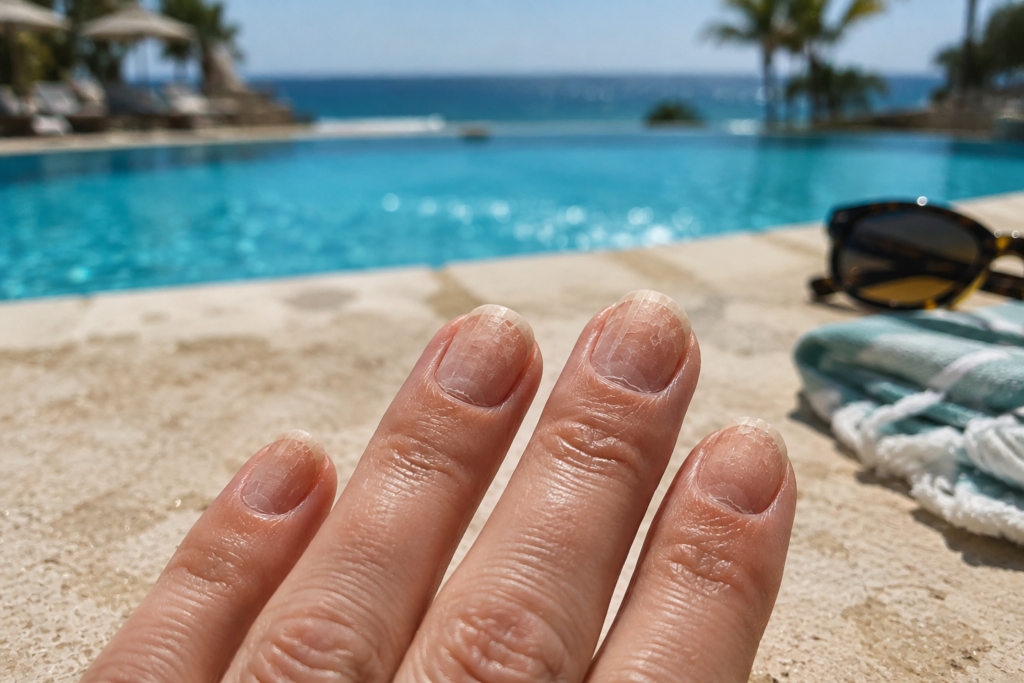
Nails that are dehydrated tend to feel brittle, not flexible. They snap cleanly rather than tearing. The surface may look dull or chalky. Peeling happens in thin, papery layers. Cuticles crack and lift. The whole area around your nails feels tight and uncomfortable.
This is not weakness. This is drought.
What actual nail weakness looks like
True nail weakness is structural. It’s about how the nail plate is built, not how much water it’s holding.
Weak nails bend under pressure. They fold. They don’t snap cleanly because there’s not enough density to create a clean break. The nail plate itself is thin. Growth is slow. Damage heals poorly.
This tends to be genetic, hormonal, or the result of long-term damage. It doesn’t shift with the seasons. Moisturising helps the surface, but it won’t change the underlying structure.
Dehydration is temporary. Weakness is a longer conversation.
Why people confuse the two
Both conditions make nails feel fragile. Both make polish chip faster. Both create frustration when you’re trying to grow your nails out.
The overlap in symptoms means people reach for the wrong solutions. They buy strengthening treatments for nails that just need hydration. They slather on cuticle oil, hoping it will fix nails that need structural support.
You can’t hydrate your way out of genuine weakness. You can’t strengthen your way out of dehydration.
How to tell which one you’re dealing with
Here’s a simple test.
Press gently on the tip of your nail. Does it bend and spring back? That’s usually weak nails. Does it feel rigid but brittle, like it might snap? That’s dehydration.
Look at the surface. Dehydrated nails often have a rough, dry texture. Weak nails tend to be smoother but too flexible.
Think about timing. Did this start recently, or has it always been this way? Dehydration comes and goes. Weakness persists.
Pay attention to your environment. If your nails are worse in winter, after swimming, or following gel removal, you’re probably looking at dehydration.
What dehydrated nails actually need
If your nails are dehydrated, the fix is straightforward. Not instant, but straightforward.
Cuticle oil. Daily. Twice daily if you can manage it. The oil doesn’t just sit on top; it absorbs into the nail plate and surrounding skin. This makes the whole structure more pliable and less prone to cracking.
Learn more about the importance of Cuticle Oil
A good hand cream matters too. Dry skin around the nails pulls moisture away from the nail plate. Keep your hands hydrated, and your nails follow.
Avoid over-washing if possible. If you can’t avoid it because of your job or routine, reapply oil more frequently.
Give it two weeks. Dehydration responds to consistent care faster than most people expect.
What weak nails actually need
Weak nails need structure.
No amount of oil is going to create density that isn’t there. What helps is building a protective layer that reinforces what you have.
This is where builder gel, hard gel, or acrylic come in. Not as a cosmetic choice, but as a practical one. These systems create a shell that supports the natural nail while it grows. They reduce flex. They protect against damage. They give you a fighting chance to grow length without constant breakage.
Learn more about how enhancements can support your natural nails
For some people, weak nails improve with biotin or diet changes. For most, the improvement is modest at best. Supplements take months to show any effect, and results vary wildly.
Structural support works immediately.
Where the two overlap
Here’s where it gets tricky.
You can have weak nails and dehydration at the same time.
If your nails are structurally weak and you’re also dealing with dryness, you need both approaches. Hydration keeps the nail plate supple. Structural support prevents breakage. One does not replace the other.
This is why blanket advice rarely works. “Just use cuticle oil” doesn’t solve weak nails. “Just get acrylics” doesn’t solve chronic dehydration.
You need to address what’s actually happening.
Why this matters for nail services
If you come to me saying your nails are “weak”, my first job is figuring out what that actually means.
Are they dehydrated? Then we talk about hydration routines, product recommendations, and possibly a break from certain services to let the nail recover.
Are they structurally weak? Then we discuss builder options, realistic lengths, and maintenance schedules that protect rather than stress the nail.
Are they both? Then we layer the approach.
Knowing the difference shapes everything. The service I recommend. The products you use at home. How we manage your expectations for growth and durability.
Start with the simple fix
If you’re not sure which category your nails fall into, start with hydration.
Two weeks of consistent cuticle oil and hand cream will tell you a lot. If your nails improve noticeably, you were dealing with dehydration. If nothing changes, you’re looking at a structural issue that needs a different approach.
Either way, you’ll have more information than you had before.
And that’s the point. Guessing wastes time. Testing gives you answers.
Your nails might not be weak. They might just be waiting for you to give them what they actually need.