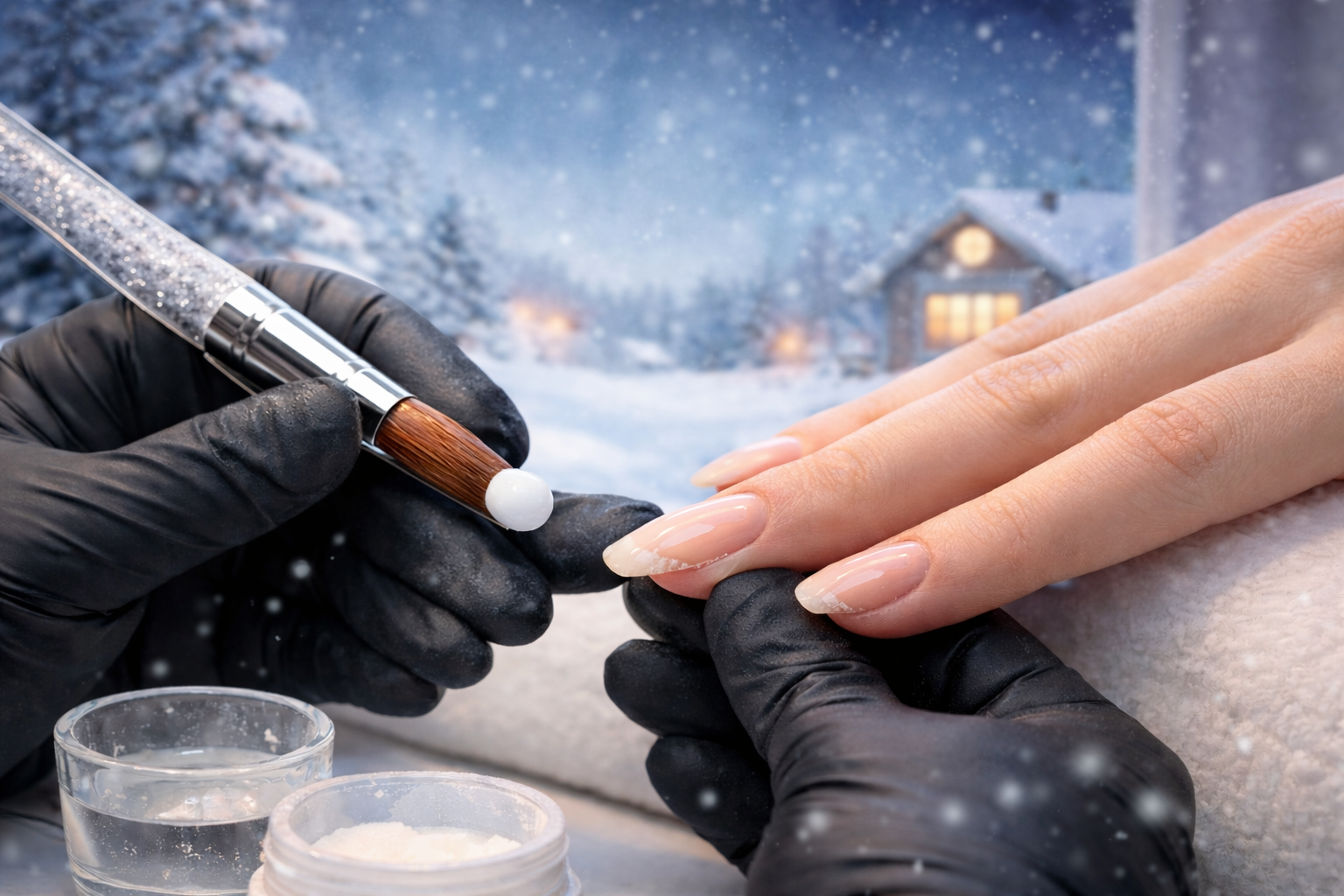
Winter is brutal on nails. Cold air outside, dry heat inside, hands in and out of gloves, constant washing. Natural nails hate all of it. Softer gel systems struggle too, even when applied well.
Acrylic does not magically solve winter. It does, however, tolerate it better than most people expect when compared to alternatives.
That difference matters.
What winter actually does to your nails
Winter strips moisture from everything. Skin, cuticles, and the nail plate itself. Nails become harder, drier, and less flexible. That rigidity is where problems begin.
A natural nail needs a small amount of flex to survive daily life. When that flex disappears, stress concentrates in predictable places. Sidewalls. Cuticle area. The stress point where the free edge begins.
This is why people see cracking, peeling, and sudden breaks during colder months, even if nothing else has changed.
Why acrylic copes better with seasonal stress
Acrylic is not soft, but it is stable.
Once cured and properly structured, acrylic holds its shape rather than flexing with every movement of the natural nail underneath. That sounds harsh, but in winter, stability beats softness.
A well-built acrylic overlay or extension redistributes stress across the entire nail rather than allowing it to concentrate in one weak area. The nail underneath is supported instead of left to fend for itself in a dry, hostile environment.
That is why acrylic sets often outlast builder gels and basic gel manicures during winter, especially on clients who are hard on their hands.
Structure matters more than product
This is where acrylic gets blamed unfairly.
When acrylic fails in winter, it is rarely because acrylic is “too hard”. It fails because the structure was wrong from the start.
Flat acrylic has nowhere to send pressure. Thin apexes collapse under stress. Over-filed cuticle areas lift the moment skin tightens and shrinks in cold weather.
Winter exposes poor structure fast. Acrylic simply makes that failure more visible.
A properly structured set, with balanced thickness and a clear apex, is far more forgiving when hands are dry and nails are under constant pressure.
The myth of winter lifting
Lifting is often blamed on cold temperatures. In reality, winter lifting is usually a skin problem, not a nail problem.
Dry cuticles creep. Skin contracts. The product cannot stay bonded to skin that is migrating across the nail plate.
Acrylic does not cause this. Neglected cuticle care does.
In winter, oil is not optional. It is part of the service life cycle. Without it, even the best application will struggle.
When acrylic still fails in winter
Acrylic is not indestructible. There are clear limits.
If nails are used as tools, acrylic will break. If gloves are constantly pulled on and off without care, corners will catch. If hands are repeatedly soaked, the nails shrink and flex repeatedly, which leads to lifting of the acrylic.
Picking is the fastest way to destroy any enhancement, acrylic included. Cold weather increases skin dryness, which increases picking. That cycle alone accounts for a significant amount of winter damage.
Acrylic can compensate for the environment. It cannot override behaviour.
Short acrylic nails outperform long ones in winter
This is not an opinion. It is physics.
Short acrylic nails experience less leverage, less torque, and fewer accidental impacts. In winter, when dexterity is reduced by gloves and cold hands, this matters.
Short does not mean weak. A short, structured acrylic nail is often stronger and longer-lasting than a dramatic length that constantly catches on fabric and seams.
Winter is not the season for fighting your lifestyle.
Acrylic versus softer systems in cold months
Builder gels and soft overlays rely on controlled flex. That flex is useful when nails are hydrated and skin is stable. In winter, it becomes unpredictable.
Acrylic remains consistent in its properties once cured, regardless of ambient temperature. It does not soften in warm rooms or stiffen further in the cold.
For clients with naturally dry nails, a good nail care routine, or hands that spend a lot of time in gloves, acrylic often delivers fewer surprises between appointments.
The real takeaway
Acrylic lasts better in winter because it is stable, structured, and more tolerant of stress. Not because it is hard. Not because it is old-school. Not because it is aggressive.
It fails when prep is rushed, structure is ignored, or aftercare is dismissed as optional.
Winter exposes weaknesses. Acrylic just tells the truth sooner.
If you want nails that survive winter, the answer is not always a different product. Sometimes it is a better build, realistic length, and hands that are treated with a little more respect.
Next week, we are talking about why short acrylic nails are not a compromise at all.
Find out which product is best for you with our interactive Service Matcher.