It starts the same way for almost everyone.
You qualify. You get insured. You build a little price list based on what other people seem to charge. You start booking in friends, then friends of friends, then strangers. You feel busy. You feel like it is working.
Then, one month, the numbers do not add up.
Not in a way that stops you in your tracks. Just a quiet shortfall. A card payment that comes out before the money lands. A product order that suddenly feels expensive. A week where you worked every day and still were not sure what you actually earned.
That moment is not a failure. It is the natural consequence of running a business without knowing what it truly costs.
What “Your Numbers” Actually Means as a Nail Tech
This phrase gets thrown around a lot, usually by people who already know theirs. For anyone just starting out, or stepping into self-employment for the first time, it can feel vague and unhelpful.
So here is what it actually means.
Your numbers are the handful of figures that tell you whether your business is surviving, struggling, or growing. They include what it costs you to do each service, what you are actually earning per hour once expenses are deducted, how much you need to bring in each month to cover your bills, and how much of what a client pays you is genuinely yours to keep.
That is it. No spreadsheets full of formulas. No accounting degree required. Just clarity on what comes in, what goes out, and what is left.
Why Most Nail Techs Avoid Looking at Their Finances
It is not laziness. It is usually a mix of overwhelm, fear, and not knowing where to start.
When you trained, the focus was on technique. Filing, application, nail art, hygiene. The business side, if it was covered at all, probably got half a day. There was a brief mention of insurance and a suggestion to “keep your receipts.”
Nobody sat you down and said: before you post your first price list, work out what a full set actually costs you to deliver.
So the prices get copied. Rounded down a bit to feel “competitive.” And from that point, every decision about the business is based on guesswork.
This is not a criticism. It is how the majority of new nail businesses begin. The problem is not starting that way. The problem is staying that way.
What Happens When You Don’t Know Your Service Costs
The effects are slow, and that is what makes them dangerous.
First, pricing drifts. Without knowing the real cost of a service, prices get set emotionally. Too low because it feels awkward to charge more. Too high in one area and too low in another, without a clear reason for either. Discounts get offered to fill gaps in the diary, but nobody checks if those discounts are actually affordable for you.
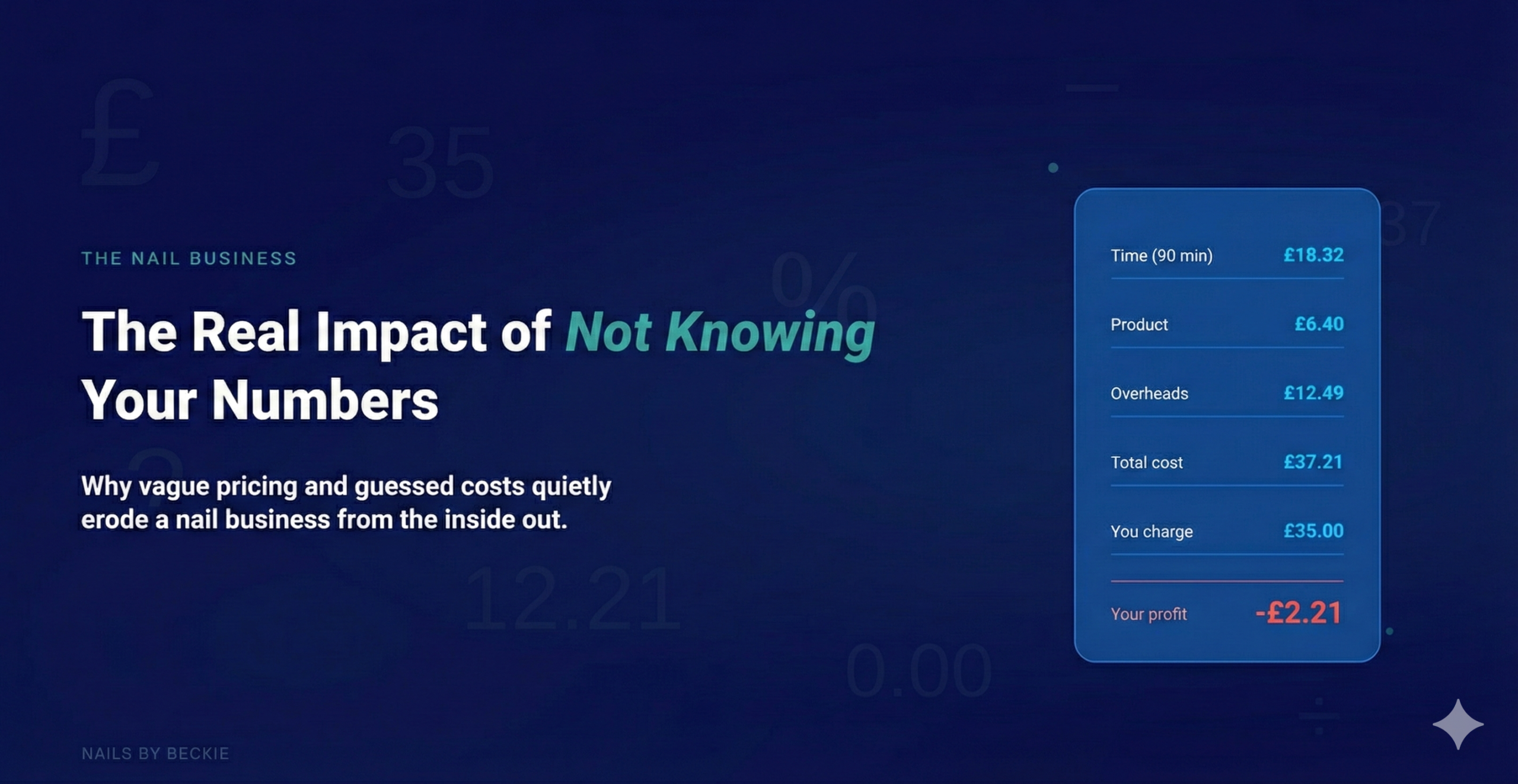
Then, time gets undervalued. A set that takes ninety minutes gets priced the same as one that could be done in sixty, because the price was never built around time in the first place. The longer services start to feel draining, not because of the work, but because the reward does not match the effort.
Eventually, the business feels hard in a way that has nothing to do with skill. Fully booked weeks that leave very little in the bank. A growing resentment towards clients who are not doing anything wrong. A suspicion that maybe this just is not sustainable.
None of those feelings come from being bad at nails. They come from not having the information to make better decisions.
The Cost of a Service is NOT Just Product
This is one of the biggest blind spots for newer techs.
Product cost is real, and it matters. But it is only one part of the bigger picture. A full set of acrylic does not just cost the price of the powder, the liquid, and the tips. It costs the electricity running the extractor. It costs a share of the rent, or the insurance, or the fuel to get to a mobile booking. It costs the wear on tools that will need replacing. It costs time, and time is the one resource that cannot be restocked.
Until all of that is factored in, the price on the list is a guess. And guessing with money, month after month, is how a business slowly runs itself into the ground without ever having a single dramatic crisis.
You Do Not Need to Become an Accountant
This is important to say clearly, because the fear of “doing the numbers” often comes from imagining it has to be complicated.
It does not.
Knowing your numbers can start with a single afternoon and a calculator. Work out what you spend each month on the non-negotiables: insurance, rent or room hire, products, tools, marketing, phone bill, fuel. Add it up. That is your baseline. That is the amount you need to earn before you have made a single penny of profit.
Then look at your prices. Subtract the rough product cost per service. Subtract the time it takes. See what is left. If the answer is uncomfortable, that is not a reason to panic. It is a reason to adjust.
Pricing is not permanent. It is a decision, and decisions can be changed once the information is there to support them.
What Changes When You Finally Know Your Numbers
The shift is not dramatic. It is quiet and steady.
Prices stop feeling like guesses. Discounts stop being given without thought. Bookings start being assessed not just by whether the slot is filled, but by whether the service is worth the time it takes. Conversations about money with clients feel less awkward because the reasoning is real.
And perhaps the most underrated change: the guilt fades. The guilt about charging what a service is worth. The guilt about saying no to a booking that does not work financially. The guilt about raising prices when costs go up.
Numbers replace guilt with logic. Not cold, corporate logic. Just the quiet confidence of knowing the business is built on something solid.
This is NOT About Squeezing Every Penny
Knowing your numbers is not about becoming ruthless or transactional. It is about protecting the business you are building.
A nail business that does not understand its own finances is fragile. One price increase from a supplier, one quiet month, one unexpected bill, and the whole thing wobbles. A nail business that knows its numbers can absorb those hits because there is a margin there by design, not by luck.
The goal is not to maximise profit at all costs. The goal is to make sure the work is sustainable. That it pays properly. That it does not quietly drain the person doing it.
How to Start Tracking Your Numbers Today
If this post has hit a nerve, that is a good sign. It means the awareness is already there.
The next step does not need to be a full financial overhaul. It can be one thing.
Pick your most popular service. Work out what it costs you in product, time, and overheads. Compare that to what you charge. If the gap is smaller than expected, that is the starting point for every pricing decision that follows.
One service. One honest look. That is enough to begin.
Get the free Service Cost Explainer
To make this easier, I have put together a simple, free Service Cost Explainer that walks you through the maths step by step. No jargon, no complicated formulas. Just a clear breakdown of your time cost, product cost, and overheads so you can see exactly what each service costs you to deliver.
Pop your email address below, and I will send it straight to your inbox.
Thank you!
The Service Cost Explainer is on its way to your inbox.
This post is the first in a short series on the business side of being a nail tech. The next post looks at what “busy” really means when the diary is full, but the bank account tells a different story.